
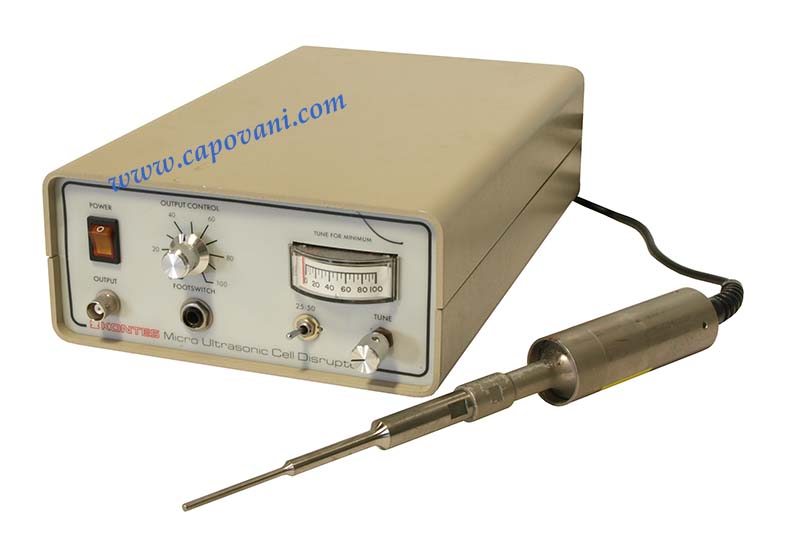
Ultrasonic Disintegrators

Ultrasonic disintegrators use high-frequency sound waves to disrupt cell structures and facilitate homogenization. They ensure precise and consistent results in laboratory environments.

Common Applications

cell disruption

emulsification

nanoparticle dispersion

extraction of plant compounds

sample preparation

de-gassing of liquids

Buying Guide

Ultrasonic Disintegrators Buying Considerations

  • Evaluate the required power output, ensuring it matches your sample size and type.
  • Check for included accessories like probes or horns for varied applications.
  • Assess the ease of operation and available control options, such as amplitude and pulse settings.
  • Consider the material compatibility to prevent sample contamination.
  • Select a model with a robust and reliable cooling system to avoid overheating during prolonged use.

Frequently Asked Questions

What are ultrasonic disintegrators used for?
Ultrasonic disintegrators are used to break down cell walls, mix samples, and homogenize laboratory materials.
How do ultrasonic disintegrators work?
They operate by emitting ultrasonic waves that create microscopic bubbles, which implode and exert forces to disrupt cells and particles.
What industries use ultrasonic disintegrators?
They are popular in pharmaceuticals, biotechnology, and material sciences for sample preparation and processing.
Can ultrasonic disintegrators handle large volume samples?
Yes, they can be used to process both small and large volume samples with appropriate equipment configurations.